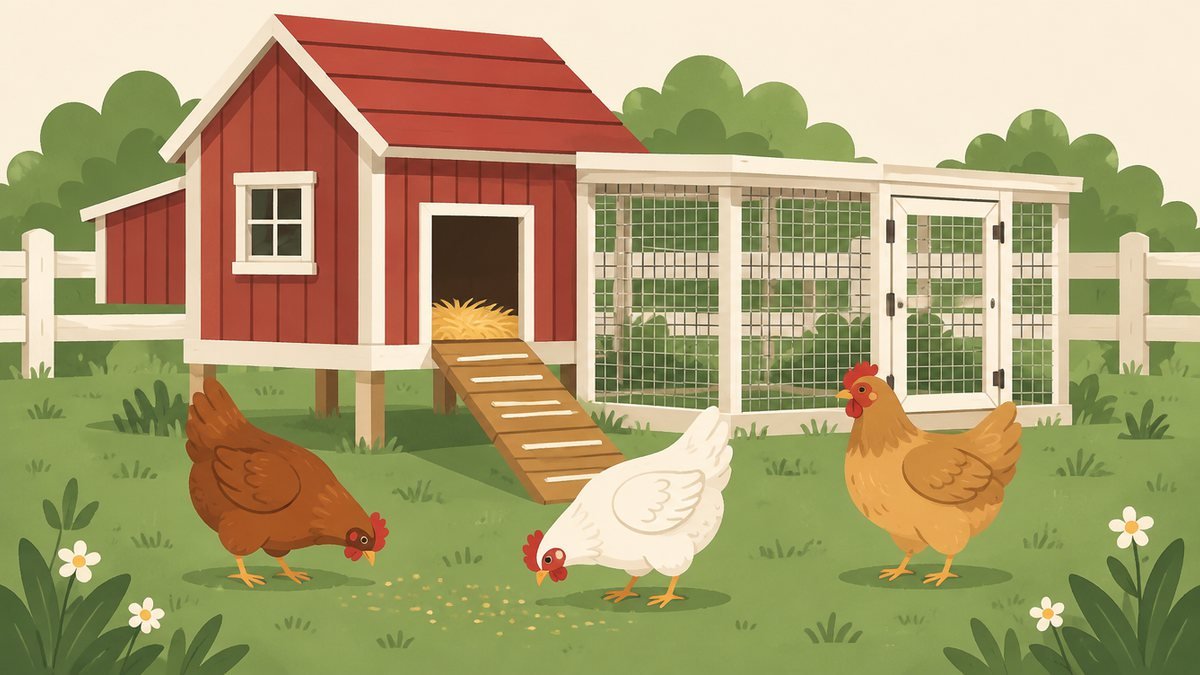
A chicken coop needs dry shelter with enough floor space for every bird, ventilation that moves air without blowing on the flock, roosts to sleep on, nest boxes for laying and walls and a floor that shut predators out at night. University extension guides put indoor space at roughly 2 to 3.5 square feet per hen, with more room in the fenced run outside.
The numbers differ between universities because climate, breed and the amount of time hens spend indoors differ, so the table below sets the main ranges side by side. When two guides disagree, the larger figure is the safer choice for birds that spend long winter days inside.
The short list
| Part of the coop | Range in the guides | Where it comes from |
|---|---|---|
| Indoor floor space | 2 to 3.5 square feet per hen | Penn State Extension (2), NC State Extension (2.5 to 3.5), University of Georgia Extension (3 to 3.5) |
| Space with a run | At least 3 square feet indoors per bird; 4 to 5 square feet per bird in the fenced run | Oregon State Extension (3 indoors), NC State Extension (4 to 5 outdoors) |
| Space with no run | 8 to 10 square feet per bird | Oregon State Extension |
| Roost bar | 5 to 10 inches of pole per bird, set 18 to 24 inches above the floor | Oregon State Extension, Penn State Extension, UC Cooperative Extension (6 to 10 inches) |
| Nest boxes | About 12 by 12 inches; one box for every four hens | Penn State Extension, Oregon State Extension |
| Litter | About 4 inches of dry shavings on the floor; 3 inches in nest boxes | NC State Extension, Penn State Extension |
| Ventilation | Openings that exchange air without drafts on the birds | Oregon State Extension |
| Predator protection | Fencing buried 6 inches to 1 foot, closed at night | Oregon State Extension, NC State Extension |
| Lighting for layers | 14 to 16 hours of light a day, natural plus artificial | Penn State Extension |
Floor space
Space is the number people most often get wrong, because a coop that looks roomy with three pullets feels cramped with eight hens. The table gives the range, and the practical rule is to count the birds you will keep in two years, not the ones you are buying now. Oregon State Extension recommends at least 3 square feet per bird when the flock also has a run and 8 to 10 square feet per bird when it does not, and a coop does not need to be insulated, so floor area is where your budget buys the most comfort.
Crowded birds peck at each other more and leave litter wetter. The lower figures you may see online, as little as 1.5 to 2 square feet, come from commercial egg barns, not backyard coops, which is why NC State Extension suggests giving considerably more than the minimum where you can.
Ventilation without drafts
Birds give off moisture and ammonia from their droppings all night, so a closed coop turns damp and sharp-smelling within days. Ventilation exists to carry out ammonia, carbon dioxide and moisture and to bring in fresh air. The target is air exchange without a draft hitting the birds.
There are two ways to get there. Passive ventilation uses openings such as windows in walls or vents in gables, eaves or roofs, and it is enough for most backyard coops. Active ventilation uses electric fans in especially warm or humid weather, aimed so they do not blow directly on the flock.
Put openings high, above roost height, so moving air passes over the coop instead of across sleeping birds. Cover every opening with sturdy wire, because a vent big enough for air is also big enough for a raccoon’s hand unless it is screened.
Roosts
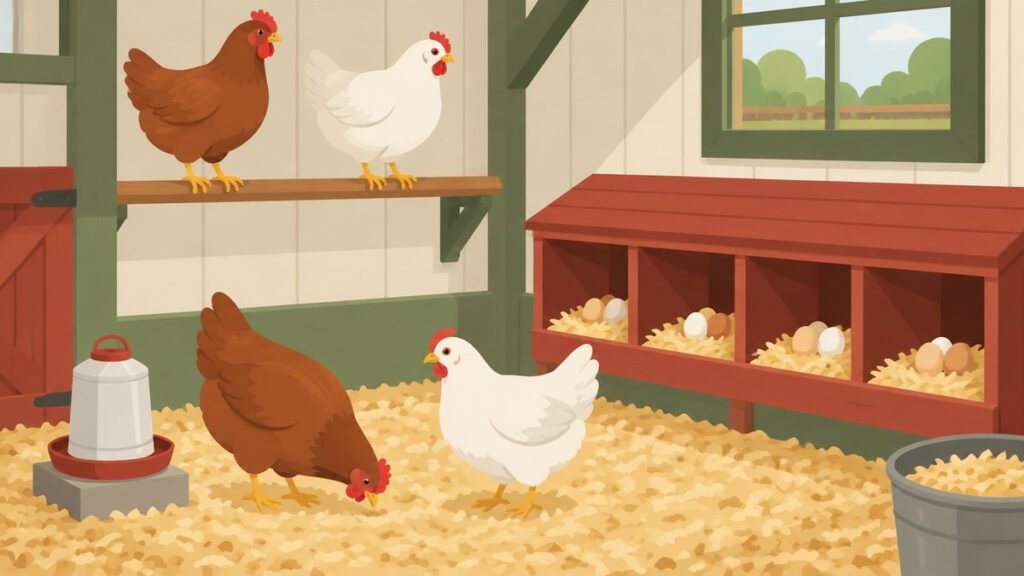
Chickens sleep perched, so a coop needs roost bars even if the floor is spotless. Poles made from 1- to 2-inch square lumber with the top edges rounded off give a good grip, because poles that are too thin or too round can cause foot problems. The guides allow 5 to 10 inches of pole per bird, with the bars about 18 to 24 inches off the floor and roughly 1 foot apart, and away from the nest boxes.
Manure collects under the roost, which is a convenience: a droppings area in one place keeps the rest of the litter cleaner. Our guide to what goes inside a coop covers roosts, nest boxes and bedding in more detail.
Nest boxes
A hen looks for a dark, secluded place to lay, so nest boxes belong in a quiet corner of the coop, off the floor and not lower than the roosts so they stay cleaner. Plan on boxes about 12 inches wide, deep and tall. The count is about one box for every four hens: Penn State Extension suggests two boxes for the first four hens and one more for every four after that.
Hens share boxes happily, so do not build one per bird. A roof sloped at 45 degrees keeps birds from roosting on top of the boxes, a 3- to 4-inch lip at the front holds bedding in and about 3 inches of clean pine shavings makes a comfortable nest.
Floors, bedding and cleaning
A floor you can clean quickly decides whether you keep up with it. Cover the indoor floor with about 4 inches of moisture-absorbent litter such as wood shavings and stir it often so it stays dry and does not cake. Pine shavings or straw work, wet or compacted litter should be cleared out promptly and slippery surfaces should be avoided because they cause leg injuries.
Design for cleaning from the start. A coop that is easy to maintain with weekly cleanings has doors that open outward so every corner is reachable, sloped floors that drain when you hose the coop out and enough room for you to step inside comfortably.
Keeping predators out
Plan the defenses before the first bird moves in. Close the flock inside every night, raise the coop at least 1 foot off the ground to discourage rats, snakes, raccoons and skunks and use secure flooring such as a concrete slab or solid wood. Enclose the run in 1- by 2-inch mesh, add netting or wire over the top and bury the fencing 6 inches to 1 foot to stop diggers such as coyotes, foxes, rodents and dogs.
One detail is easy to get wrong: fasten the run wire to the outside of the upright posts, because wire on the inside can be pushed in by a persistent predator. If burying the wire is impractical, bend it outward from the base of the fence and spread it at least 12 inches across the soil. The top of the run needs a cover too, so flying and climbing predators cannot get in. More detail on fencing is in our guide to chicken runs.
Light, power and where to put the coop
Laying hens respond to day length. Layers need 14 to 16 hours of light daily, which in winter means adding artificial light in the morning rather than at night so birds can roost at sunset, using a 25- to 40-watt bulb and never lighting adult birds more than 16 hours a day. If you run electricity to the coop, have a licensed electrician do the wiring, because dust, feathers and moisture are hard on cords and fixtures.
Choose the site for drainage and access. A spot that stays dry after rain, is reachable in bad weather and is visible from the house keeps the daily chores easy. Building near the house or other places people often go helps discourage unwanted wildlife, and large plants beside the coop can shelter predators.
Before you build, check local rules. Many ordinances set a maximum number of birds, forbid roosters or require the coop to sit a set distance from property lines, so Penn State Extension advises checking all local ordinances, zoning laws and property association rules and applying for permits if required.
A practical order of work
- Decide how many hens you will keep and add a few spare feet for growth.
- Pick a dry, accessible site and check the local rules.
- Build or buy a coop with the indoor space in the table, a floor you can clean and a door that closes securely at night.
- Add roosts and nest boxes at the heights above, then vents high on the walls covered with wire.
- Fence the run with buried or skirted wire and a top cover.
Once the coop works, the rest of the flock routine follows. Our beginner’s guide to raising backyard chickens walks through the first weeks, and the first weeks with new birds are the best time to set up feed and water.
Frequently asked questions
How much space does a chicken need in a coop?
Extension guides give roughly 2 to 3.5 square feet per bird indoors when the flock also has a run, and 8 to 10 square feet per bird when it has no outdoor access. Pick the larger figure if the birds spend winter days inside.
Does a chicken coop need to be insulated?
Not necessarily. Oregon State Extension notes that coops do not need to be insulated, but they must not have drafts, and ventilation openings are needed to carry out moisture and ammonia.
How many nest boxes do I need?
About one box for every four hens, each roughly 12 by 12 inches. Penn State Extension suggests two boxes for the first four hens, then one more for every four additional hens.
How high should chicken roosts be?
Penn State Extension places roosts 18 to 24 inches above the floor, and Oregon State Extension sets poles about 2 feet off the floor, with 5 to 10 inches of pole per bird.
How deep should I bury the run fencing?
Oregon State Extension recommends burying fencing 6 inches to 1 foot into the ground. NC State Extension also describes bending the wire outward and spreading it at least 12 inches across the soil.
Sources
The space, roost, nest box and predator figures come from the extension publications below. Local ordinances and your climate may call for different numbers.
- Living on the Land: Backyard Chicken Coop Design (EC 1644) | Oregon State University Extension
- Successfully Raising a Small Flock of Laying Chickens | Penn State Extension
- Keeping Garden Chickens in North Carolina | NC State Extension
- Management Guide for the Backyard Flock (C 969) | University of Georgia Extension
- Basics for Raising Backyard Chickens (PDF) | UC Cooperative Extension